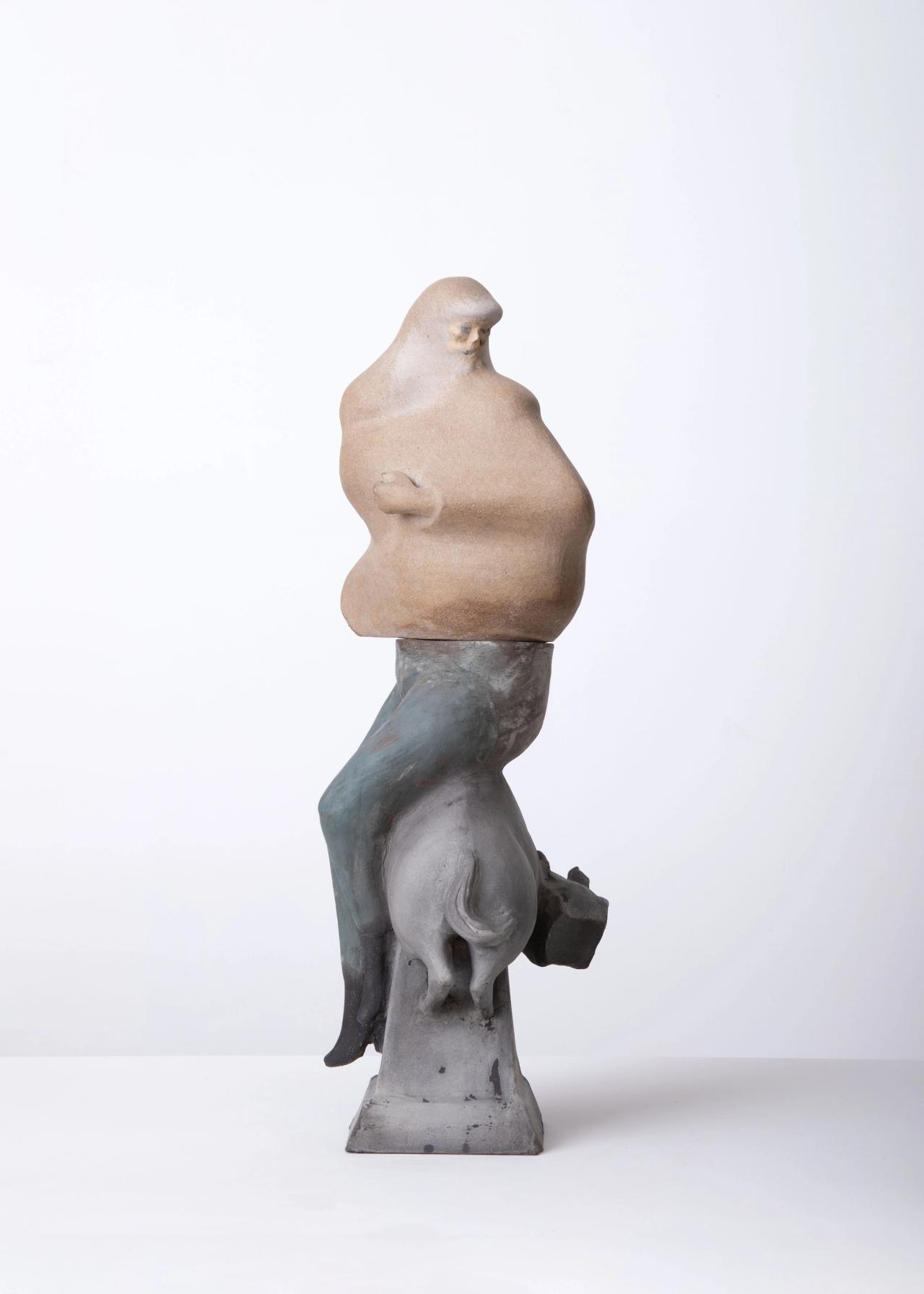
American Art presents Five Ceramics, a solo exhibition of new ceramic sculptures by Jared Buckhiester.
Q: What do you remember about your first camera?
A: It was a Sears version of the classic Nikon F100. I bought it for fifty bucks from a friend of my Mom’s when I was a junior in highschool, and it was my main camera until the lightmeter broke. I used that camera for eight years, and it traveled with me to Egypt and Syria. When my Syria pictures came back hopelessly overexposed, I got a new camera.
Q: We have talked about the works not being characters, and we have agreed that they are not.
Then what are they?
A: I may take that back. More truthfully, they are an amalgam of characters, but I try to avoid amplifying this nature when placing them for others to view. I don’t like an installation that insinuates an interaction between them.
Q: The frustration you noted in a conversation with Hilton Als, of a camera’s inability to portray memory is fascinating, you had to draw. What compelled you to photograph your sculptures?
A: I like that you are connecting my impulse to photograph my ceramics with a need to portray memory. It gets me closer to what “character” is in the ceramic figures. I admit they are in part a fictional collective memory, one that comes from film and literature. The memory is a loose collage of say Willa Cather, Faulkner, A Few Dollars More, and The Wild Bunch. Narratives of conflict in this country, but also further back than that. So in that way, I am photographing memory, and hadn’t realized it until you posed this question. The impulse to photograph is in one sense a hamfisted combination of the sculpture and painting – the ceramic sits inside a landscape, rather than what typically happens in the studio, where the ceramic sits next to a painting of a landscape. I also like the play of scale that can happen when the camera angle and perspective are used. Edward Steichen’s photograph of Rodin’s Balzac is a wonderful example of this, and I often have this in mind when taking these ceramics out to be photographed. That photograph, as well as the photos Hujar took of Nadelman’s plaster figures.
Q: What is glory to you?
A: When working with materials and taking risks, there are exciting moments when I’m surprised by what has happened. I’m surprised that my doubt and uncertainty was somehow a conduit for the object in front of me. Glory is perhaps the restful feeling that follows this surprise.
Five Ceramics Jared Buckhiester